
Sustainable Employee Merch: What the Branded Gear You Give Your Team Says
A low-cost branded hat says the unit price mattered more than the person. What your team merch communicates, and three questions to ask before you order.
A company's values statement is approved in a meeting. The branded merchandise it hands its team is chosen dozens of times, under different budget pressures and deadlines. Neither decision is treated as the same kind of communication. They are.
The merch a company gives its employees is one of the more tangible signals of how it thinks about the people who work for it. Most of the time, nobody is thinking about that signal when the order is placed. It is treated as a line item, not a message. The people receiving it do not read it that way.
What a low-cost order says
A high-volume, low-cost branded hat communicates things its buyer did not intend. It says the unit cost mattered more than whether the hat would be worn. It says the object was made for a moment, not for the person receiving it.
The hat ends up in a drawer. Its full production footprint lands on a single use, because a single use was all it was designed for. The money was spent, the material was consumed, and the brand impression that was supposed to justify the order never happens, because nobody wears the hat.
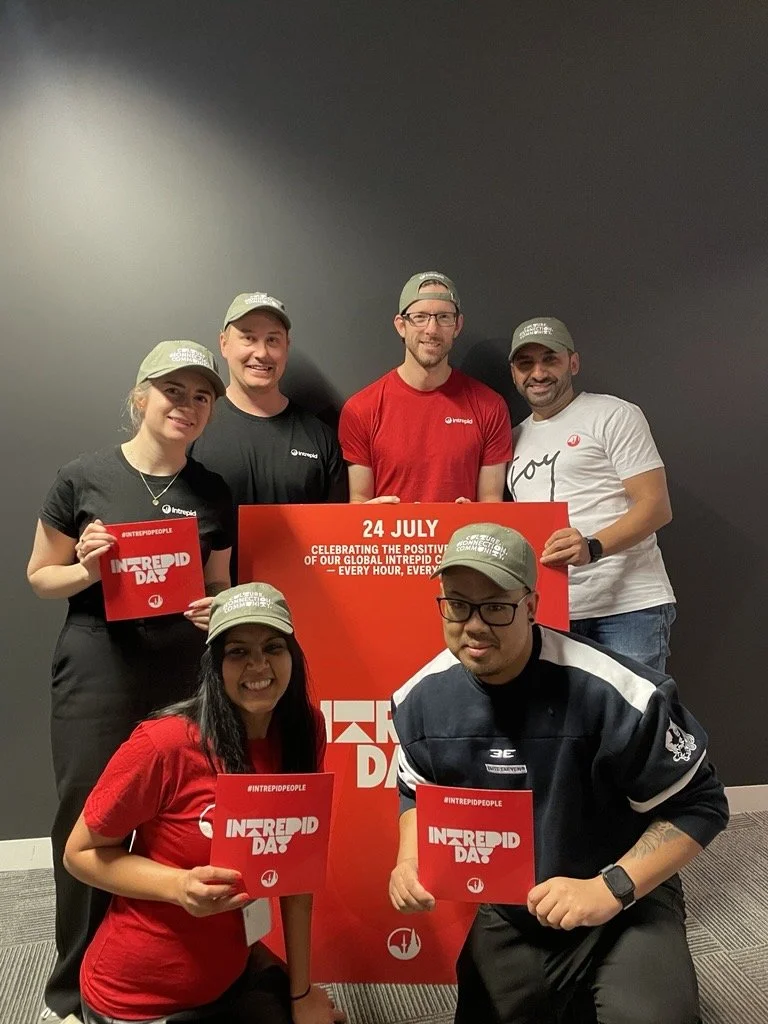
Photo Credit: Intrepid
What the data says about what gets kept
The idea that quality changes behaviour is not just intuition. Industry research consistently finds that people keep branded items when the items are worth keeping. PPAI, the promotional products industry body, reports that around 83 percent of consumers keep the promotional products they receive, and that more than half still have the last one they were given. The ASI Ad Impressions Study makes the same point more sharply: people hold on to branded merchandise when it is genuinely useful and discard it when it is not. Branded apparel in particular tends to be kept for over a year and seen hundreds or thousands of times across its life.
Read against a cap that goes straight into a drawer, those figures are the whole argument. A well-made hat that someone actually wears is a repeated, positive impression at a low cost per wear. A cheap hat that is never worn is a single production footprint with nothing to show for it. The difference is not the logo. It is whether the object was made to be kept.
Note to verify before publishing: confirm the exact PPAI and ASI figures and their publication years before citing.
What getting it right looks like
When Qatar Airways Cargo ordered caps for an internal campaign, the brief was specific: match their corporate red to an exact Pantone and deliver to Doha on a fixed date. The Pantone was matched and the caps arrived on schedule. "We received all the caps in Doha today, it looks nice. You managed to match with Pantone color," wrote Rochellina A, their Cargo Marketing Coordinator. The logistics are not the point. A cap made to a real specification, for people who will actually wear it, is treated differently from a cap bought on unit price alone.
Note to verify before publishing: confirm the Qatar Airways Cargo quote and that the client name can be used publicly.
The ESG angle: employees are watching
There is a second audience for internal merch, and it is the people receiving it. Employees, particularly those joining organisations with stated sustainability commitments, notice the gap between what a company says and what it hands them. A company that publishes an ESG report and orders the cheapest cap it can source is making a choice with that order, whether or not it intends to. The merch is a small, physical test of whether the values statement is operational or decorative.
This matters more now than it did five years ago. Expectations around employer values have risen, and the cost of visibly failing them has risen with them. The reassuring part is that getting it right does not require a large budget. It requires asking a different question before the order is placed.

Topiku for Qatar Airways’ Merch
Three questions worth asking
Who will actually wear this, and when? A hat designed around a single campaign has a shorter useful life than one chosen for daily wear. The design decision determines the lifespan.
Can you tell a story about how it was made? A named workshop, a specific material source, a production process that can be described. The story is part of what the object communicates, and it is the part a cheap order cannot offer.
Does the quantity match the actual need? Over-ordering is one of the most preventable sources of waste in branded merchandise. The right order is the quantity people will use, not the quantity that brings the unit price down.
Where to start
The most useful question before a merch order is not about which option scores highest on sustainability. It is: what do we want this object to say, and does this choice say that? A hat that people wear, made in a way you can describe, answers that question on its own.
If you want to talk through what that looks like for your team, request the custom order guide or reach out at topiku.co/custom-hats.
Works Cited
1. PPAI (Promotional Products Association International). Research on promotional product retention. [Confirm figures and year before publishing.] https://www.ppai.org/
2. ASI (Advertising Specialty Institute). Ad Impressions Study. [Confirm figures and year before publishing.]
3. Qatar Airways Cargo, client correspondence quoted on topiku.co. [Confirm quote and permission before publishing.]