We give at least 2% of annual revenue to organisations doing work we believe in, and we have met that policy every year since 2022. In 2026 that support, and the commercial partnerships alongside it, took more than one form. Funding, hats for field teams, and brand collaborations are different kinds of relationship. We report them separately, and we do not add them into a single number.
This is a record of who we worked with in 2026, how those relationships differ, and how we choose who to work with next.
Three kinds of relationship
The first is funding: a donation or a certified credit purchase, directed to work we can describe and, where the standard exists, verify.
The second is hats for the people doing the work: field teams and volunteers whose days match what our hats are built for: outdoors, in variable weather, over extended periods.
The third is a commercial alignment: a brand or supplier that makes something we do not, or that needed a maker whose standards matched its own. These are not Changemakers grants. They belong in the same year-end map because a merch buyer often meets us through them, and because the test is the same: can we stand behind how the other party works?
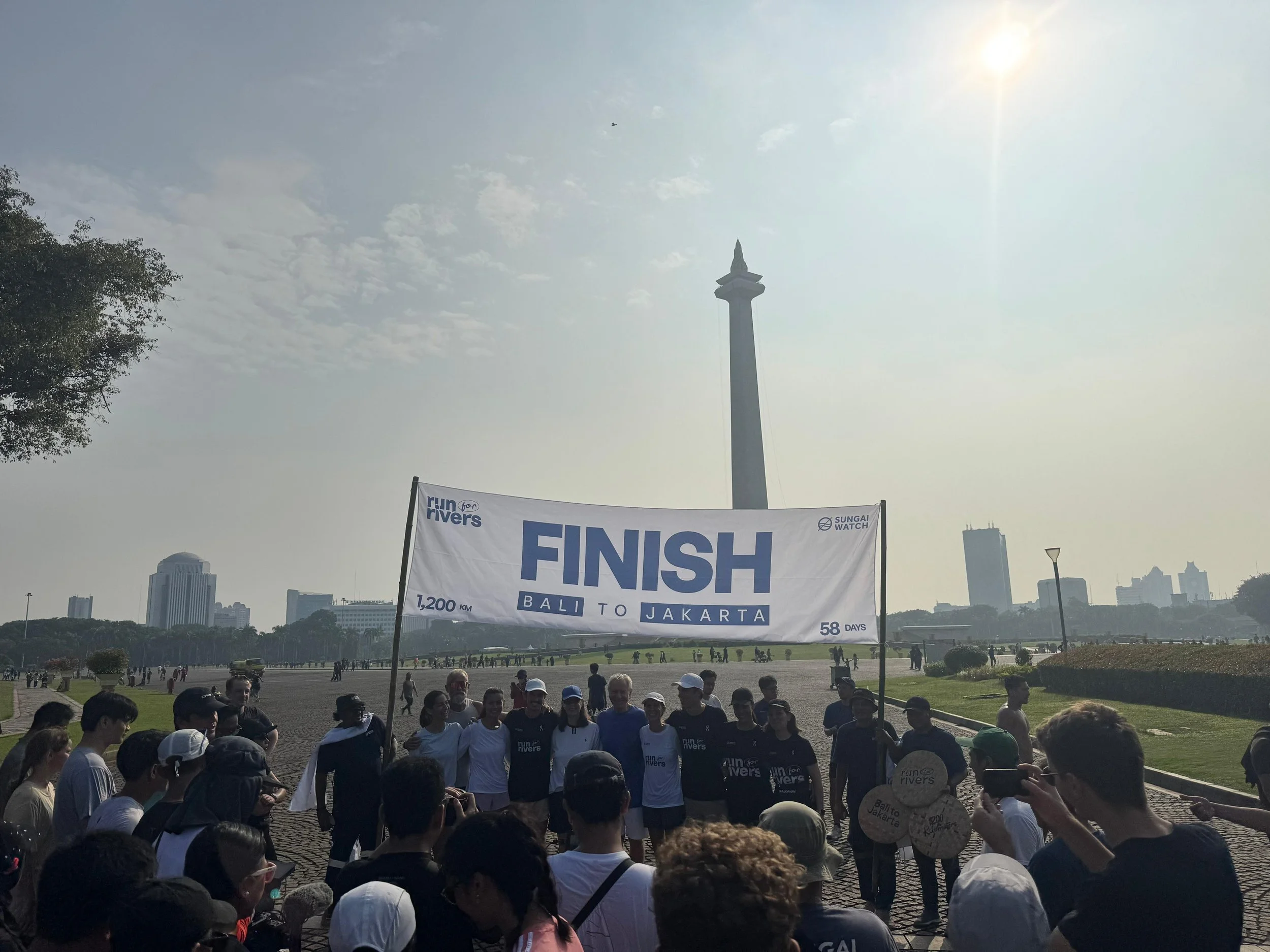
Run for Rivers campaign by Sungai Watch
2026 Funding: Sungai Watch and SeaTrees
In May we donated $1,000 USD to Sungai Watch for its Run for Rivers campaign. Sungai Watch's co-founders, Gary, Kelly, and Sam Bencheghib, ran 1,200 kilometres from Bali to Jakarta, over 58 days, to raise funds to remove plastic from Indonesia's rivers before it reaches the ocean. At the time we wrote about the campaign, the stated terms were that every dollar would go toward removing one kilogram of plastic, with collection tracked through their barrier technology and community cleanup data. We are not publishing a campaign outcome we do not have.
We also purchased 58 tons of Verra-certified carbon credits through SeaTrees' Climate Label bundle. Each ton is sourced from the Southern Cardamom REDD+ Project in Cambodia, and each is paired with one mangrove tree planted in Marereni, Kenya. That is 58 trees, tracked individually over a 10-year period. The credits are retired on our behalf through the Verra Registry.
We chose SeaTrees because of that verification standard, not because an offset is a substitute for reducing our own emissions. Reduction comes first. The purchase sits outside the footprint of an individual hat, and we report it that way.
2026 Hats for Field Teams: Adventure Scientists
Through the Changemakers Program, we make hats for non-profit organisations doing conservation work we believe in. In 2026 that included hats for the field volunteers of Adventure Scientists, a 501(c)(3) founded in 2011 by Gregg Treinish and based in Bozeman, Montana. Their volunteers collect research-grade conservation data in remote, difficult-to-access places. Their work has helped discover more than three dozen new species and has included, at the time, building what they described as the world's largest microplastics dataset.
The connection is practical. Their volunteers work in the conditions our hats are built for. The hats are made from upcycled cotton twill and a recycled HDPE brim, by the artisan team at Esduabelas in Desa Rahayu. We have not published a 2026 hat count or a delivery date for this partnership, and we are not adding either here.
Our February Changemakers post also describes earlier support for Sungai Watch field teams, the Borneo Orangutan Survival Foundation, and Living Seas Foundation, including 100 hats for BOS and 50 for Living Seas. Those figures belong to that earlier account. We are not restating them as 2026 actions.
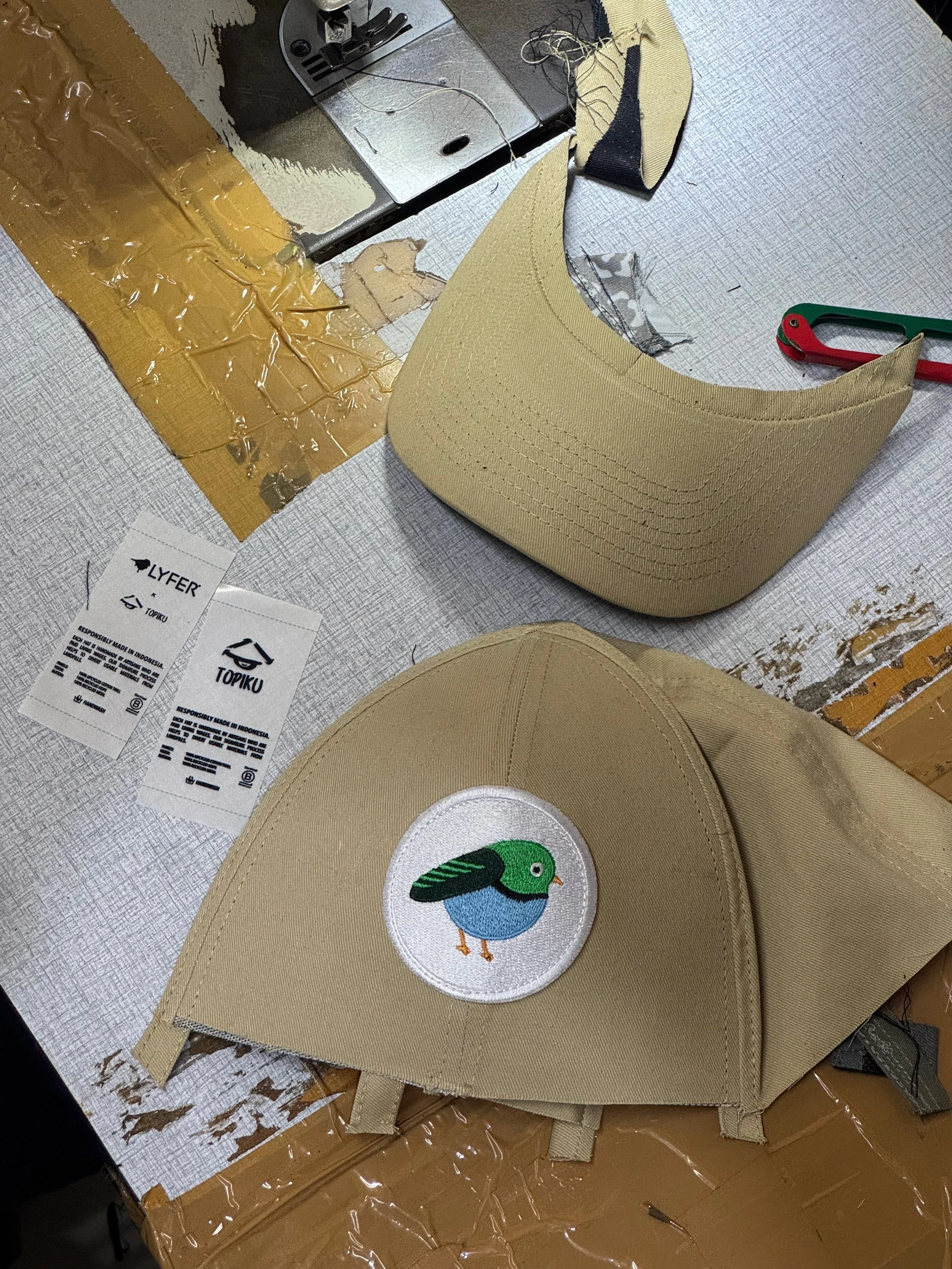
LYFER Hat in Process
2026 Commercial Alignments: LYFER and GOEX
GOEX Apparel is a different kind of alignment. GOEX is a Fair Trade Federation member and a certified B Corp, based in Kansas City and wholly owned by the Global Orphan Project. They cut and sew tees and fleece at a living-wage factory in Port-au-Prince, Haiti, using USA-sourced fabric. When a US client comes to GOEX for a full merch kit (tees, sweatshirts, and hats), GOEX refers the hat component to us. We have also made a co-branded GOEX × Topiku hat. That collaboration has existed since 2020, and we are not describing it as a 2026 launch. The referral is the 2026 fact that matters for a buyer: apparel from a supply chain you can check, and headwear from a named workshop we have paid on the same terms since 2015.
How a partner is chosen
The relationships above were not assembled for a year-end list. A few tests recur.
The work has to be specific enough to describe: a river barrier network, a Verra-certified credit, a research-grade field program, a published code of conduct. Vague "impact" is not enough.
Where we give funds or credits, the support should be structured, not occasional. The 2% minimum is a policy, not a seasonal campaign.
Where we give hats, there should be a use: weather, duration, and a job that makes a durable cap a reasonable object, not a logo drop.
Where we work commercially, the standards have to match closely enough that a client can hold both sides of a merch kit to the same questions: who made this, from what, and under what terms?
We cannot see every organisation worth supporting from Bandung. That is a limit, not a pose.
Who we should back next
If you know an organisation doing environmental or social work that you think we should support, contact us through topiku.co with its name and one line on what it does. We read every suggestion. We cannot promise to back all of them.
The same route works if you are a brand planning a 2027 merch kit and want to talk about a referral or a production run. The custom order guide is at topiku.co/custom-hats.
Works Cited
1. Topiku. The Changemakers Program: Turning Revenue Into Real-World Impact. https://www.topiku.co/blog/the-changemakers
2. Topiku. Running 1,200km for Indonesia's Rivers; Why We're Backing Sungai Watch's Run for Rivers. https://www.topiku.co/blog/running-1200-km-for-indonesia-rivers
3. Topiku. 58 Tons and Counting: Why Topiku Backs SeaTrees' Ocean Restoration Work. https://www.topiku.co/blog/why-topiku-backs-seatrees-ocean-restoration-work
4. Topiku. Why Topiku Supports Adventure Scientists Through the Changemakers Program. https://www.topiku.co/blog/why-topiku-supports-adventure-scientists
5. Topiku. Making the LYFER Hat: Inside the Collaboration and How It Comes Together. https://www.topiku.co/blog/making-the-lyfer-hat
6. LYFER. In the Making: Meet Topiku. Avian Journals, 25 June 2026. https://lyferbrand.com/blogs/avian-journals-birding-lifestyle-blog/in-the-making-meet-topiku
7. Topiku. Ethical Headwear and Ethical Apparel: Why We Partner with GOEX. https://www.topiku.co/blog/why-we-partner-with-goex
8. Adventure Scientists. About Us. https://www.adventurescientists.org/about-us.html